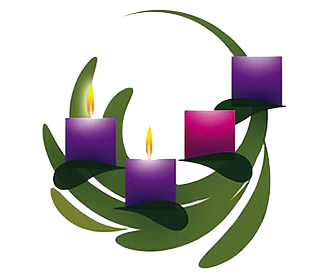
Advent Wreath
Artist: Unknown 1
Advent Wreath
Artist: Unknown 1
The History of Advent
We do not know the exact date of Christ's birth, but we know the season from the story of the shepherds who came to the manger. Historians tell us that sheep were moved to other pastures in the Fall and Winter. The actual date of Christ's birth has been a matter of speculation for the last 20 centuries and scholars of various disciplines disagree, but most agree that the birth took place in the winter.
Recent studies, such as the Bethlehem Star Project, have provided evidence that the 25th day of December is valid. Others have stated, falsely, that the date was chosen to overshadow Roman deities. Given the adversity of Christians to anything pagan, this hypothesis is very suspect,
The earliest known document, Commentary on the book of Daniel, from the writings of Hyppolytus of Rome in 204 AD, states that the Lord’s birth was believed to have occurred on the 25th of December. Hyppolytus says, “For the first advent of our Lord in the flesh, when he was born in Bethlehem, was December 25th, Wednesday, while Augustus was in his forty-second year, but from Adam, five thousand and five hundred years. He suffered in the thirty-third year, March 25th, Friday, the eighteenth year of Tiberius Caesar, while Rufus and Roubellion were Consuls.” 1
The reference to Adam can be understood in light of another of Hyppolytus’ writings, the Chronicon, where he explains that Jesus was born nine months after the anniversary of Creation. According to his calculations, the world was created on the vernal equinox, March 25, which would mean Jesus was born nine months later, on December 25. 2
Nineteenth-century liturgical scholar Louis Duchesne explains that “towards the end of the third century the custom of celebrating the birthday of Christ had spread throughout the whole Church, but that it was not observed everywhere on the same day” 3 Christmas was celebrated in the Western churches on December 25th (west in this case means the churches of Rome and of Europe), and in the Eastern Churches (Constantinople and others) on January 6th, the date we now celebrate as the Solemnity of the Epiphany. The date for Christmas, in the Eastern Churches, was changed to December 25th sometime in the late fourth century.
However, perhaps more importantly, is the spiritual and symbolic meaning of the time of Christ's Birth. Christmas is celebrated near the Winter Solstice. “The winter solstice is the day with the shortest period of daylight and longest night of the year, when the Sun is at its lowest daily maximum elevation in the sky.” 4 The solstice, and the position of the stars, was very important at the time for agricultural and many other reasons. Thus, the spiritual significance is that Our Savior comes to us in our hour of greatest need. He came to those in Roman captivity, to those in captivity to sin, and to us as Light at a time of our greatest darkness.
There are few documents that provide information about the origins of Advent. Given the lack of documentation, it is reasonable to assume that the Season of Advent grew out a popular devotion of the people, and was later adopted by the Church. This is supported by the writings of Hyppolytus who speaks of advent in a general way, meaning the coming of Christ. The Season of Advent may have originated in certain local churches and later was adopted universally by the Church. However, without additional evidence it is impossible to claim with confidence exactly when the Season of Advent became widespread.
According to the Catholic Encyclopedia, Advent began sometime after the 4th century as a time of preparation for Epiphany, and not in anticipation of Christmas. Epiphany celebrates the manifestation of Christ by remembering the visit of the wise men and, in some traditions, the Baptism of Jesus. At this time new Christians were baptized and received into the faith, and so the early church instituted a 40-day period of fasting and repentance. This would explain the differnce in dates of the celebration of Christmas. Originally, at least in some churches, it was not the coming of the Christ-child that was anticipated, but the Second Coming of Christ.
According to Saint Gregory of Tours the celebration of Advent began in the fifth century when the Bishop Perpetuus directed that starting with the feast of St. Martin, on the 11th of November, until Christmas, one fasts three times per week. Advent was called the Lent of St. Martin. This practice remained limited to the diocese of Tours until the sixth century. 5
The Council of Macon in 581 adopted the practice already established in Tours and soon all of France observed three days of fasting a week from the feast of Saint Martin until Christmas. The most devout worshipers in some countries exceeded the requirements adopted by the Council of Macon, and fasted every day of Advent. The homilies of Gregory the Great in the late sixth century mention a period of four weeks in the liturgical season of Advent, but without the requirements of a fast. However, under Charlemagne in the ninth century, writings claim that the fast was still widely observed. 6
In the thirteenth century, the fast of Advent was not commonly practiced although, according to Durand of Mende, fasting was still observed by some. As quoted in the Bull of Canonization of St. Louis, the zeal with which he observed this fast was no longer customarily observed. The observance of Advent was shortened to the period from Solemnity of Saint Andrew until Christmas Day, since the solemnity of this Apostle was more universally known than that of St. Martin.
When Pope Urban V ascended the papal seat in 1362, he charged his court to practice abstinence, but there was no suggestion of fasting. It was then customary in Rome to observe five weeks of Advent before Christmas. This is particularly discussed in the Sacramentary of St. Gregory. Ambrosian or Milan Liturgies observed six weeks. The practice of the Greeks shows no real consistency; Advent was an optional fast that some begin on 15 November, while others begin on 6 December or only a few days before Christmas.
The first clear liturgical references in the Western Church to Advent occur in the Gelasian Sacramentary, which provides Advent Collects, Epistles, and Gospels for the five Sundays preceding Christmas and for the corresponding Wednesdays and Fridays.
Advent was first celebrated on the 40 days prior to Christmas and required fasting on Monday, Wednesday, and Friday. Later the time was shortened to 5 weeks and the fasting requirement was changed to abstaining from meat on those same days. Still later the abstinence requirement was removed for the laity, but was still in force for the clergy. However, traditions varied regarding the practice of penitence during the weeks in Advent.
The liturgy of Advent remained unchanged until the Second Vatican Council, in 1963, which introduced changes which differentiated the spirit of Advent from that of Lent. The changes emphasized Advent as the fulfillment of Christ's Coming in Bethlehem and as a season hope of His Second Coming. Today, there are no specific fasting or abstinence requirements, except for the normal Friday abstinence.
Advent has two seasons. The first two weeks of Advent are a time of repentance and penance and the Sunday readings direct our minds to the Second Coming of Christ. The manner in which we offer our penance is left to each individual. In the second season, the days from December 17th until Christmas, the focus is on the joyful anticipation on the Birth of Our Savior. Hope and gratitude are emphasized as a response to our Messiah's Loving Kindness.
There is great wisdom in the Feasts and Seasons of the Church. The celebration of the Seasons of the Church tie us to our ancestors, and remind us that God has been, is, and will be with us throughout our salvation history. The Advent Season affords the opportunity to share in the ancient longing for the Coming of the Messiah,
Many of the feasts we celebrate date back to to the antiquities of Sacred Scripture, and originated in God's guidance of our Jewish ancestors in the faith. Today the Church continues and fulfills these ancient feasts. For example::
And Advent may have borrow some of the traditions of Hanukkah, particularly in the lighting of candles. Hanukkah celebrates God's Presence among us. Hanukkah is called the Festival of Lights. It celebrates the re-dedication of the Second Temple in Jerusalem. Christmas is also a, 'Festival of Light', in that it celebrates the 'Incarnation: the Light of Revelation, the person of Christ among us.” Today, we celebrate Advent in repentance, in the lighting and blessing of candles, and in prayer and preparation for the Light of Incarnation on Christmas day.
References
Images
See Tabs: (Resources / Website / Image Resources) for common image sources.